
Linea Viva

Milan, IT
Apartment Renovation and Interior Design
approx. 150 sqm
Completed
Construction Company Edilservizi Fumagalli
Custom-made furniture Novarredo
Photographer arch. Tommaso Meraviglia

The project involved the spatial reconfiguration of the entire apartment, which had remained unchanged in terms of materials and proportions since the years of its construction.
The demolitions and the new planning of the spaces have the aim of making the light coming from the windows on a single side of the apartment perceptible right from the entrance with the main objective of "opening" the space and visually expanding it.
At the same time, despite operating on a small surface area, essential functions and spaces such as a second bathroom and a laundry area have been added.
The living area is now large and bright with a generously sized peninsula kitchen that meets the client's request, a passion for food preparation.
The living area also hosts a space dedicated to relaxation and one for dining and is clearly distinct from the sleeping area thanks to a full-height flush-to-the-wall door that also visually interrupts the long corridor, the only distribution axis of the apartment.
Further ahead, in the sleeping area, the space compresses to introduce us to the corridor that leads us to the more intimate and private spaces of the house.
A continuous structure was designed to connect the two parts which, although interrupted by the large pivoting door, contains various containers.
At the entrance, a wardrobe structure with sliding doors was created and it dialogues and interacts, through an oak panel that extends towards the dining area, with the different souls of the living space.
In the corridor of the sleeping area, the volume continues with two columns with shelves, joined by an open oak box-shaped compartment, creating additional space for storage and container.


The living room is conceived as a large, open-plan space, defined as a single fluid environment in which different functions coexist without rigid hierarchies.
The full-height, wall-to-wall bookcases trace the perimeter of the room, becoming a continuous architectural presence that organizes the space and defines its character.
Within this setting, two large, freely configurable sofas act as flexible devices, capable of reshaping the spatial layout and creating different modes of seating and gathering.
The kitchen opens onto the living area, establishing a direct dialogue with the main space, while still maintaining its own identity thanks to the L-shaped configuration, which allows it to be perceived as an independent room.
This balance between openness and separation defines a subtle threshold, offering different ways of using and experiencing the space.
A small dining nook, located adjacent to the study, completes the kitchen composition.
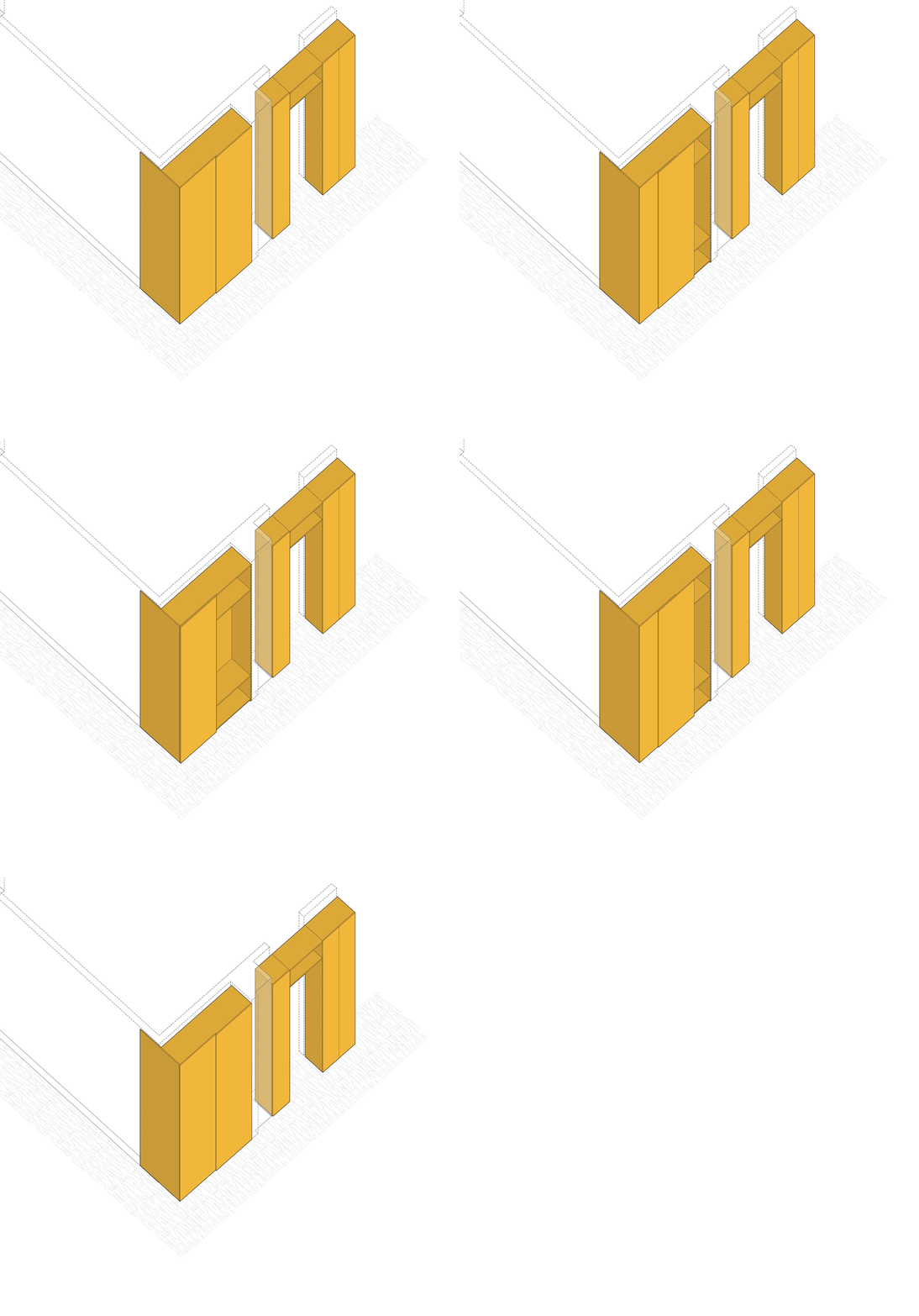
To connect the two areas of the space, a built-in storage structure was designed.
Although interrupted by the large pivot door, it continues into the living area.
At the entrance, a wardrobe system with sliding doors was created, framed by an oak panel that extends toward the dining area.
In the corridor leading to the sleeping area, the volume continues with two shelving columns, joined by a bridge element that is essentially an open box-like oak unit, providing additional storage and display space.